The result in one line
We started the Pot with 100 notional units and staked every bet by Kelly. After 270 settled bets it stands at 99.69. Put a flat 1 unit on the same bets and it would stand at 106.37.
That looks like a clear win for flat staking. It is not, for two reasons: flat staked almost twice as much money, and 270 bets is nowhere near enough to separate the two.
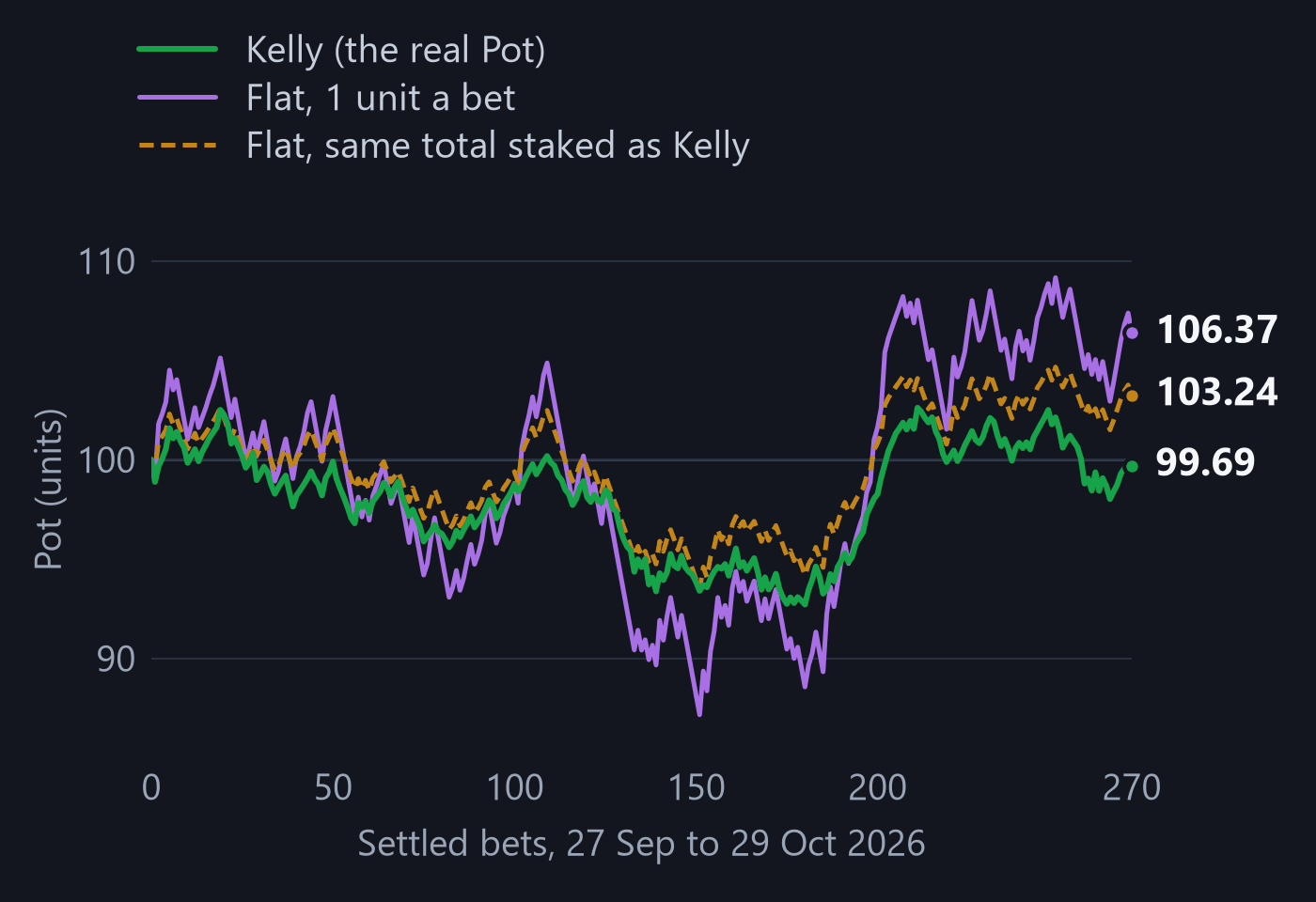
All 270 settled Pot bets in settlement order, 27 September to 29 October 2026. Every line starts at 100 notional units. No real money is staked.
What we compared
The Pot is a shared, notional pot in our VIP Lounge. It bets when the best available price beats our fair price by 2% to 10%, at odds from 1.50 to 4.00. Each stake is one-eighth of full Kelly, capped at 2% of the pot.
For this test everything stays the same: the same 270 bets, the same odds, the same order and the same results. 144 bets won and 126 lost. Only the stake changes:
- Kelly: what the Pot actually did. Stakes ran from 0.08 to 1.35 units and averaged 0.51.
- Flat, 1 unit: 1 unit on every bet, never adjusted. That is about double the average Kelly stake.
- Flat, same money: 0.508 units on every bet, so the total staked matches Kelly exactly.
The third line is the fair fight. Without it, you are comparing a plan that staked 270 units with one that staked 137.
The numbers
| Measure | Kelly | Flat, 1 unit | Flat, same money |
|---|---|---|---|
| Finish (from 100) | 99.69 | 106.37 | 103.24 |
| Total staked | 137.27 | 270.00 | 137.27 |
| Return on money staked | -0.2% | +2.4% | +2.4% |
| Highest point | 102.61 | 109.15 | 104.65 |
| Lowest point | 92.70 | 87.16 | 93.47 |
| Biggest drop | 9.6% | 17.1% | 8.9% |
Flat at 1 unit went higher and fell further. It dropped from 105.11 to 87.16 by bet 151, when it was more than 6 units behind Kelly. Anyone following it in mid-October would not have called it the winner. It led Kelly for 61% of the 270 bets.
The same-money line is the awkward one for Kelly. It finished 3.55 units ahead, and it led for 99% of the run. Its biggest drop was also slightly smaller. The smoother ride Kelly is known for did not show up here.
Why Kelly finished behind
Kelly sizes a bet by its edge relative to the price, so short prices get bigger stakes. With the same 3.6% edge, the Pot stakes about 0.75 units at odds of 1.60 and 0.18 units at odds of 3.50.
That matters because of how each price band ran. Expected is the sum of our fair chances for those bets, and the last two columns show units won or lost.
| Odds | Bets | Won | Expected | Kelly stake | Kelly | Flat 1 unit |
|---|---|---|---|---|---|---|
| 1.50 to 1.79 | 123 | 76 | 79.4 | 0.62 | -4.07 | -1.93 |
| 1.80 to 2.09 | 66 | 31 | 35.7 | 0.50 | -1.87 | -6.52 |
| 2.10 to 2.49 | 38 | 22 | 17.8 | 0.44 | +3.98 | +10.78 |
| 2.50 to 2.99 | 18 | 6 | 7.0 | 0.33 | +0.74 | -2.01 |
| 3.00 to 4.00 | 25 | 9 | 7.6 | 0.21 | +0.91 | +6.05 |
The shortest prices, where Kelly staked most, landed 3.4 wins under expectation. The two bands that beat expectation by the most got smaller stakes.
Nine bets did most of the damage. Kelly put 1 unit or more on nine bets, all at odds of 1.94 or shorter. Our fair chances said about 5.6 of them should win. Three did. Those nine cost Kelly 4.27 units, against 1.82 at the same-money flat stake. That is 2.45 of the 3.55-unit gap, from 3% of the bets.
Is flat staking better, then?
Not on this evidence. We resampled the 270 bets 20,000 times to see how much the result could move by chance alone:
| Measure | 95% range |
|---|---|
| Flat, return on money staked | -9.8% to +14.7% |
| Kelly, return on money staked | -12.2% to +11.8% |
| Flat minus Kelly | -3.6 to +8.9 points |
Flat came out ahead in 79% of the resamples. That is a lean, not a verdict. Both plans sit comfortably inside each other's range.
Two other figures point the same way. Our fair chances expected 147.5 wins and 144 landed, so both plans ran slightly cold. And the odds taken beat the last market price we saw before kick-off by 2.3% on average, with 76% of bets ahead of it. That check does not depend on the stake at all, which is why the Pot is judged on it rather than on its balance.
This test also barely touches what Kelly is for. Its main advantage is compounding: stakes grow with the pot and shrink as it falls. A pot that has stayed between 92.70 and 102.61 has not compounded anything. Flat staking has the opposite habit. At 87.16 units, a 1-unit stake has quietly grown to 1.15% of the pot.
What this means for your own staking
- No reliable chance for each bet? Stake flat. Kelly needs a probability, and if yours is too high it stakes too much. Flat needs no estimate at all.
- Using Kelly? Use a small fraction and a cap. The Pot uses one-eighth with a 2% limit. Our Kelly Criterion guide shows the formula.
- Compare on money staked, not the final balance. A bigger stake swings further both ways, and that says nothing about the plan.
- Judge over hundreds of bets. The 1-unit line was more than 6 units behind Kelly at bet 151 and 6.68 ahead at bet 270.
For the wider picture on stake sizes and limits, read our bankroll management guide.
What happens to the Pot now
Nothing changes. The Pot stays on one-eighth Kelly. Its rules are next reviewed at 500 settled bets, and the test at that point is the price check above, not the balance.
The small print
- The Pot is notional. No real money is staked, and the flat lines are a calculation, not bets anyone placed.
- All odds are the best available across bookmakers when each bet was published. You may not get the same prices, so your own results would differ.
- The figures leave out four test bets from before launch and four bets still open on 30 October.
- These are our own records. They have not been independently audited.
- The longest losing run in these 270 bets was eight. Past results do not predict future ones, and any bet can lose.
Bet responsibly
A staking plan manages risk. It cannot turn a losing bet into a winning one, and it cannot create an edge that is not there. Set a budget before you start and never chase losses. 18+ · BeGambleAware.org · Only stake what you can afford to lose.